
Oh My Context

Dear Reader,
The computer my friend sent me is having some warming up issues. It had not been used for so long, understandably it reacts to it. It’s the first time I am witnessing how a laptop behaves when it gets too darn hot too darn quick. Black screen, burning case, blasting fans, alarming noise. I flip it and put it like a tent, screen facing the table, the back facing a fan. After a few minutes it allows me to shut it down, then once off it cools. At the moment, it’s being repaired, hopefully it shall work and we shall get back to work.
Here, the uncanny allegory doesn’t escape me. What if we could flip the human world, turn our faces to our planet and our universe in a relational manner, shut down the abusive systems that kill life, protect what matters most, wait for the Earth, for the harmed ones to recover from the overheating, overproduction and destruction we are causing, and do our share of repairs?
There is no not writing about heat in the middle of summer and avoiding the elephant in the room. We must weave with our planetary context. And context is in my mind fairly often these days because I am yet to write the context of the second book of Single Seed Tale and this time I humbly wish not to be drowned in the vast ocean of contexts and learn how to stay on the surface and float.
To celebrate this occasion, and to buy time before the computer comes back and we organize our second article about Istanbul, I thought I’d share with you the context of the first book that would probably not be published in English, even though the story might.
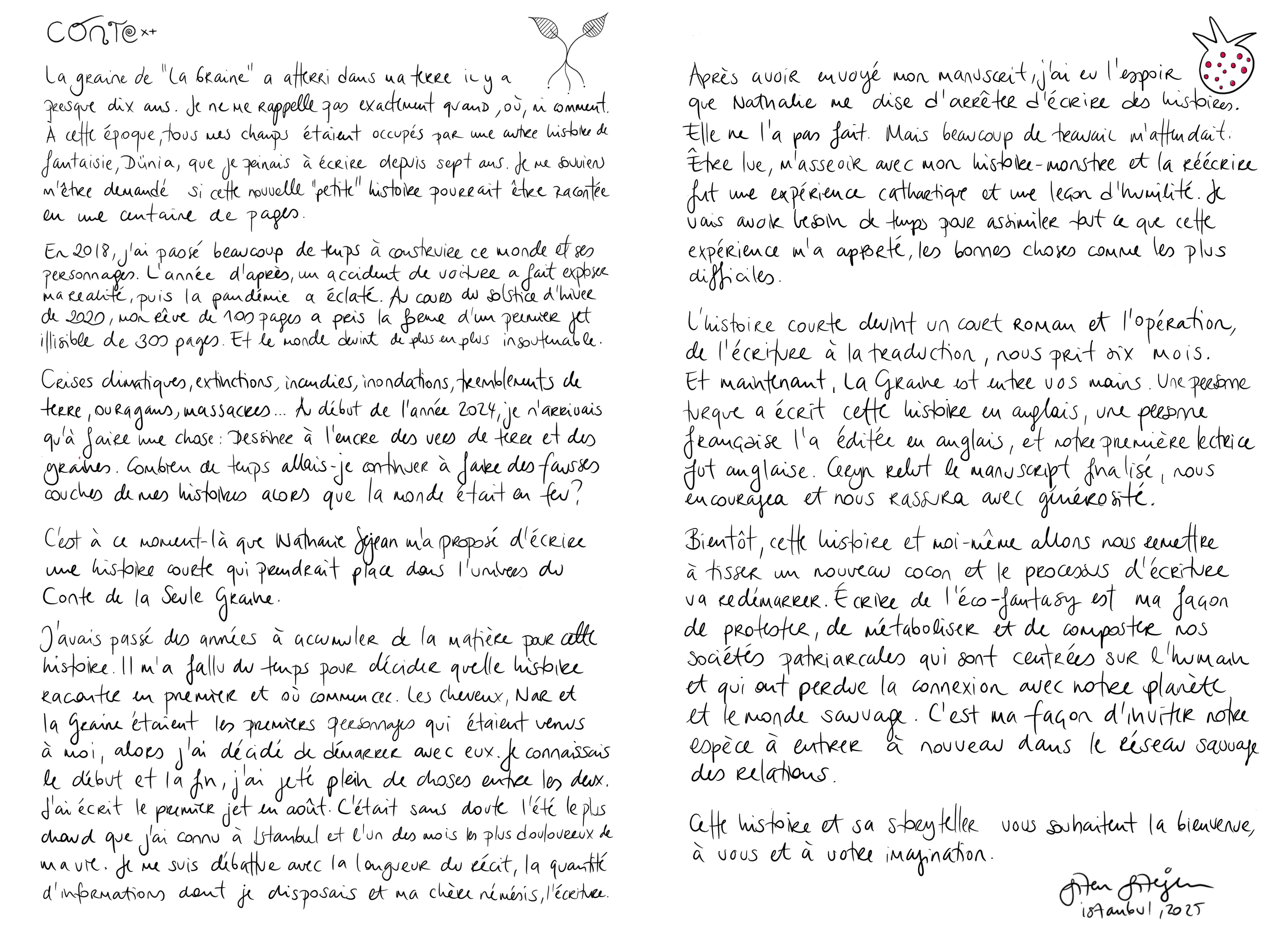
La Fourmi Éditions has a tradition, they ask their writers to compose a context with their own handwriting and they publish it inside the book so the readers can have a piece of handwritten whisper about how their story came into being.
It’s beautiful, really.
And it was also quite horrifying for me.
What is a context?
The word context comes from Latin, contexere which means to weave or join together.
Context is the environment, setting, matrix, embeddedness where and when people, happenings, words, objects, creatures, creations coexist and cogenerate. It grounds, it frames, it surrounds, it weaves everything together. Context makes a big difference, it changes the way we see things and it reminds us it is all relative. Without context, we might misunderstand the situation and each other. When you don’t share the same reality with another, you must do a lot of explaining to describe your context, where you are coming from. And this has been one of the troubles for me as a Turkish writer who lives in Turkey, imagines fantasy stories, writes in English and gets published in France.
I create fantasy worlds because I don’t want to write about my reality and I want us all to share a place, a framework where and when our imaginations can get together. And because context is deeply embedded in reality, trying to pen one felt at times as hard as writing the first draft of La Graine, the Seed.
I huffed and puffed about it for weeks. I crawled on the ground. I even tried to convince my publisher to end my agony. “Please don’t make me write a context,” I begged her. “It hurts. Let me just write fiction…” She did not flinch, recommended that I stick to the creative process and just share a piece of the journey. Context is a part of their identity as a publishing house and it is important.
“It does not have to be this heavy,” she reminded me. I knew what she was saying was right but it was bigger than me for a while. Eventually, I rose up to the occasion, and with her trust and support, I managed to pen a context in English, she translated it into French and I copied her translation onto the page with my own handwriting.
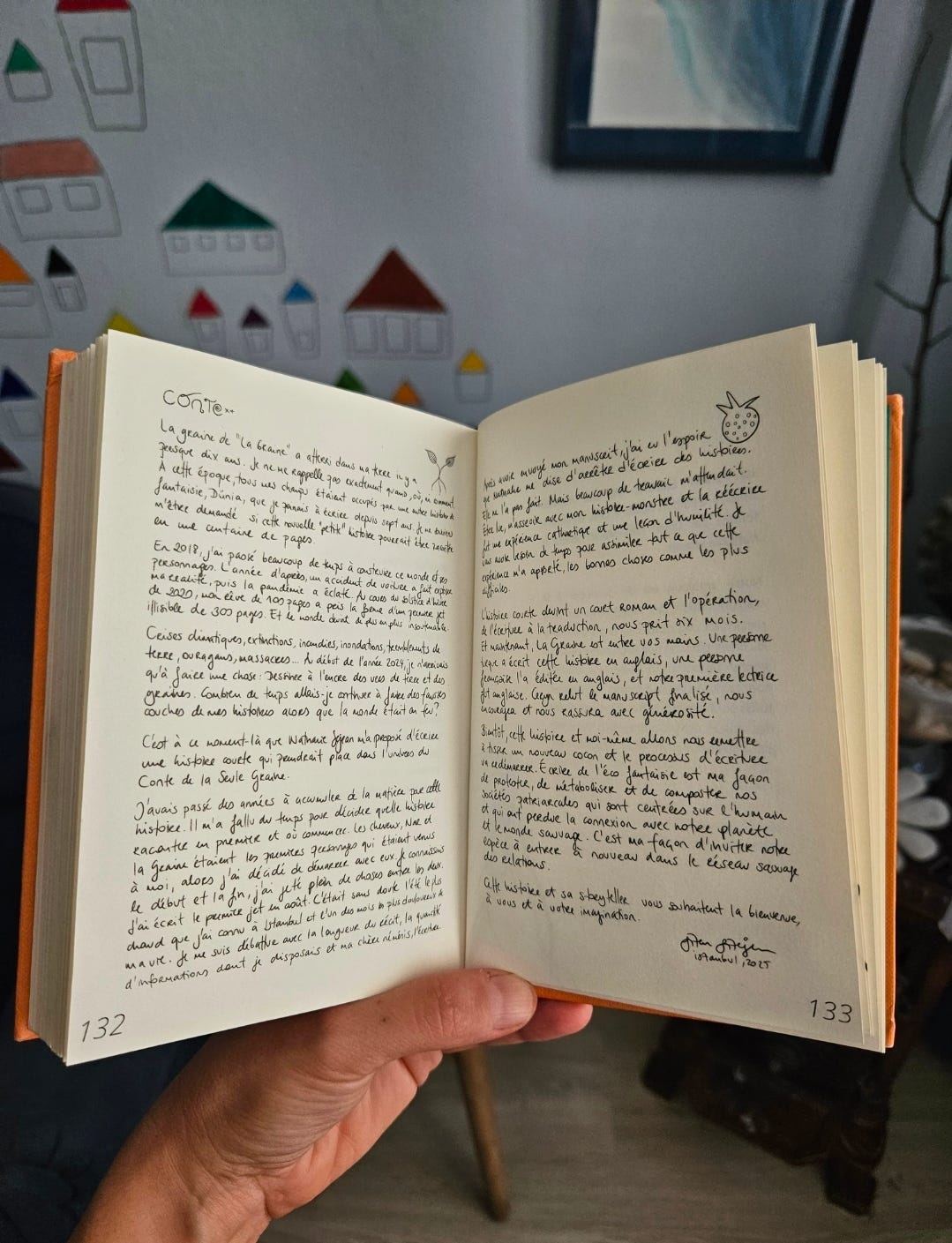
The Context I Wrote For the First Book : The English Text:
The seed of “La Graine” fell into my soil nearly a decade ago. I cannot quite recall when, where, and how. Back then all my fields had been filled with another fantasy story named Dünia for about seven years and I was struggling to write. I just remember wondering… if this new “small” story could be told in a hundred-page book.
In 2018, I did plenty of character and world building. The next year, a car crash wrecked my reality and then the pandemic broke. On the Winter Solstice of 2020, my 100-page dream turned into an unreadable 300-page first draft. And the world became increasingly unbearable.
Climate crisis, extinctions, fires, floods, earthquakes, hurricanes, massacres… At the beginning of 2024, all I could do was to ink worms and seeds on paper. How much longer could I continue miscarrying books on a burning world?
Around that time, Nathalie Sejean offered me to pen a short story out of the Single Seed Tale universe to be published.
Having accumulated for years, I had so much story material. Deciding whose story to tell first and at what point of that story to begin took me some time. Hair, Nar and Seed were the first characters that came with the story and I began with them. I knew the opening and the ending, and I threw a bunch of things in between. I wrote the first draft in August. It was possibly the hottest summer of Istanbul and one of the most painful months of my life. I struggled with the length, the sheer amount of story I had and overall my dear nemesis, writing.
Upon sending my first draft, I hoped that Nathalie would tell me to stop writing stories. She did not. But there was a lot of work ahead. Being read, sitting with my story monster, and rewriting were humbling and cathartic experiences. It will take me some time to reflect on lessons, gifts and troubles.
Eventually, the short story became a short novel that took us about six months to complete from writing to translation. Now, it is in your hands... A Turkish person wrote this story, a French person edited it and our first reader was English. Ceryn also proofread the story, cheered and reassured us generously.
Soon enough, the story and I shall weave another cocoon and begin the writing process again. That is my way of protesting, metabolizing and composting the human-centric patriarchal societies who lost their connection with their planet and wilderness, and invite our species back to the wild web of relationships.
The story and the storyteller welcome you, your curiosity and imagination.
Context can be a difficult and complicated beast to deal with. It might be a tool to manipulate, to reaffirm a certain kind of story and even to evade responsibility. Yet without it, we may not be able to interpret a situation and truly understand each other. We may come to easy conclusions without really knowing, or project or impose our own context, our own truth to another. Like with any kind of beast we must be diligent, intelligent and most importantly relational when we tend to context.
Thank you for reading Storytelling Planet. I’ll try not to get bitten by my own context beast this time, wish me luck. And I wish us all luck through this hot eclipse season. Let’s keep breathing, dehydrating, participating and braiding our manes after all it is a lioness eclipse.
Gizem Gizegen, 2026, Istanbul, ☉ Leo ☽ Taurus, incoming Leo solar eclipse and new moon
Recent Book-Related Articles
We Know Its Name

The ball is an important storyteller that millions, even billions watch, listen to, and circulate its stories. The World Cup is a giant storytelling event that engages almost the entire human world.
Nebula Drafts, Mysterysend Chapters and the Second Book

Spring greeting readers, dreamers, friends, foes, travelers from the 41st parallel north.
Story Dough and My Grandmother's Börek

There are a few things I wish I would have figured out earlier. Who doesn’t?
Fantasy Rooted in Ecology

Writer’s note: This piece is an attempt to start a conversation around ecological fantasy without exhausting the name, or the concept. My wild hope is that one day, ecology would be implied in everything we do, in everything we are, in everything we feel, sense, think and imagine. Therefore, we would not need to put it as an addition, as a label, as a c…